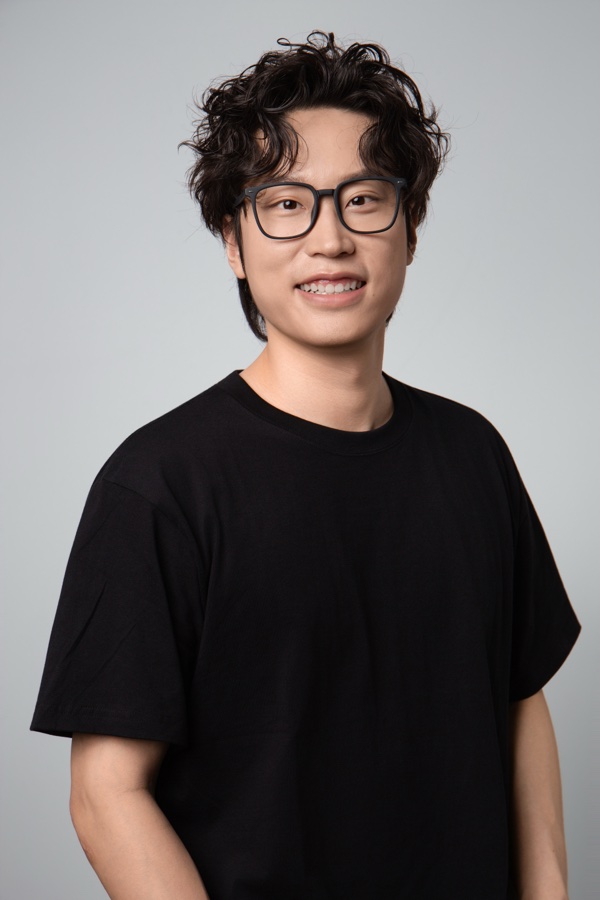
Haonan Wang

Haonan Wang

王淏楠/ Hàonán Wáng /

Principal Research Scientist Tencent Hunyuan@Singapore

I am a Principal Research Scientist at Tencent Hunyuan, where I work on reinforcement learning for multimodal generation and lead UniRL, our open-source RL framework for post-training foundation models toward agentic multimodal generation. I received my PhD in Computer Science from the National University of Singapore in Feb 2026, advised by Prof. Kenji Kawaguchi; before that, a PhD student at UIUC with Prof. Jingrui He, and B.S. in CS & Statistics at UIUC mentored by Prof. Jiawei Han.

My research has been one bet made repeatedly: scaling — and, each time an axis saturates, finding the next one. The chart below is that story.

Intelligence climbs a staircase of scaling laws.

By 2023, OpenAI had made the path to general intelligence legible: capability follows compute, along a log curve — every doubling buys a roughly constant step of capability. But a logarithm is also a promise of saturation: on any single axis, the next FLOP buys less than the last, and eventually the curve goes flat.

So the frontier doesn't ride one curve — it stacks them. Each time an axis saturates a new one opens, the climb re-bases, and you can read the stages straight off the training pipeline: pretraining params & data, longer context across pretrain and midtrain, post-train RL that thinks longer, tuning-free test-time — parallel thought and interaction — and now modality. My research is a series of bets on where the next curve begins; each colored curve below is one of those bets, and the papers it produced.

total compute — train + test (log scale) capability params + data pretrain — the industry's climb · 2020–23 context — read longer midtrain, long context · 2024 post-train — think longer RL for reasoning · 2025 beyond one pass test-time, no tuning · 2025 beyond text — the world see it · generate it · 2025 → now the next axis? …diminishing returns Every curve flattens. The climb does not. Technology keeps finding a new dimension to rise along.
the frontier, as each axis opens staying on the old axis hover a curve · click a dot to read that chapter
Prelude · ≤ 2023

I trained in the retrieval era — item retrieval at Alibaba (WWW 2021, first author), document retrieval at MSRA (Neural Corpus Indexer, NeurIPS 2022 Best Paper, core author). Then scaling reset what progress meant, and I moved onto the staircase.

Axis 01 · Context scaling 2024

Scale what the model readslonger context → more intelligence

Intelligence begins with capacity: a model that can hold more of the world in one context is simply smarter. So I worked where long context is actually made: schedule the context window during pretraining (SkyLadder), and repair the numerics that silently break RoPE at long range (AnchorAttention).

Pretraining

SkyLadder: Better & Faster Pretraining via Context Window Scheduling

Short→long context scheduling: up to +3.7% on benchmarks with up to 22% faster pretraining.

NeurIPS 2025 · co-author · Sea AI Lab

Mid-training

When Precision Meets Position: BFloat16 Breaks Down RoPE in Long-Context Training

Diagnosed the BF16 × RoPE breakage; AnchorAttention restores positional coherence and cuts long-context training time.

TMLR 2025 · first author

Axis 02 · Post-training · RL 2025

Scale what the model thinksmore thinking → more intelligence

Intelligence also lives in time: give the same weights longer to think, and they are smarter — trained with RL, where the bottleneck is the reward signal. VeriFree drops the verifier, carrying RLVR beyond math and code; Variational Reasoning supplies the theory — thinking traces as latent variables.

RL without verifiers

Reinforcing General Reasoning without Verifiers

Verifier-free RL matches verifier-based training on MMLU-Pro / GPQA — and extends it to unverifiable domains.

ICLR 2026 · core author · Sea AI Lab

Probabilistic view

Variational Reasoning for Language Models

Thinking traces as latent variables: ELBO → multi-trace objectives, with a forward-KL that stabilizes training.

ICLR 2026 · co-author · Sea AI Lab

Axis 03 · Test-time · beyond one pass 2025

Scale beyond a single passmore minds, more turns → more intelligence

One chain of thought saturates too. So scale test time itself, without touching the weights: in width, fork K reasoning traces and merge their logits into one answer (Think in Parallel, Answer as One); in depth, treat interaction with the environment as its own scaling axis (MiroThinker).

Parallel · width

Think in Parallel, Answer as One: Logit Averaging for Open-Ended Reasoning

K traces think independently, one voice answers — +8.3 pass@1 on LiveCodeBench-hard (DeepCoder-14B).

ICLR 2026 · first author

Sequential · interaction

MiroThinker: Model, Context & Interactive Scaling

Open deep-research agents — interaction depth scales like parameters and context (up to 600 tool calls per task). MiroThinker-1.7 & H1 add verification for heavy-duty agents.

2025–26 tech reports · core contributor · MiroMind

Axis 04 · Beyond text 2025 → now

Scale into the worldmore of the world → more intelligence

Text is one projection of the world — and it is running out. The modality axis scales what a model can perceive and what it can create: Next-Event Prediction turns unlabeled video into reasoning supervision; UniRL — my current chapter at Tencent Hunyuan — puts one RL loop under multimodal generation. Generation is the strictest test of understanding — what I cannot create, I do not understand.

Understand · video

Fostering Video Reasoning via Next-Event Prediction

Future segments as self-supervision (V1-33K, FutureBench): temporal reasoning from unlabeled video.

ICLR 2026 · co-first author · Sea AI Lab

Generate · now

UniRL: One RL Loop for Agentic Multimodal Generation

Open-source RL post-training across text, image and video — rollout, reward, advantage estimation, log-prob replay and distributed training, unified for heterogeneous model families.

Tencent Hunyuan · project lead · 2026 →

Every plateau hides a takeoff. What is the next axis?

Read longer → think longer → think wider → act longer → sense and create beyond text. Each jump was visible about a year early — to anyone watching where marginal returns were thinning. I spend a lot of time staring at the top-right corner of that chart.

Think you see the next curve? I'd love to argue about it · 欢迎来聊。

News

// recent updates

Publications

// selected — see Scholar for full list

left stripe = first / co-first author  ·  * denotes joint first author  ·  colored chip = its axis in the thesis chart

2026EMNLP

From Harm to Help: Turning Reasoning In-Context Demos into Assets for Reasoning LMs

Haonan Wang, Weida Liang, Zihang Fu, Zheng Nie, Yifan Zhang, Yao Tong, Tongyao Zhu, Hao Jiang, Chuang Li, Jiaying Wu, Kenji Kawaguchi

Empirical Methods in Natural Language Processing EMNLP 2026

2026ICLR

Think in Parallel, Answer as One: Logit Averaging for Open-Ended Reasoning

Haonan Wang, Chao Du, Kenji Kawaguchi, Tianyu Pang

International Conference on Learning Representations ICLR 2026

2026ICLR

Fostering Video Reasoning via Next-Event Prediction

Haonan Wang*, Hongfu Liu*, Xiangyan Liu, Chao Du, Kenji Kawaguchi, Ye Wang, Tianyu Pang

International Conference on Learning Representations ICLR 2026

2026ICLR

Prefix-Tuning+: Modernizing Prefix-Tuning through Attention Independent Prefix Data

Haonan Wang, Brian Chen, Siquan Li, Xinhe Liang, Tianyang Hu, Hwee Kuan Lee, Kenji Kawaguchi

International Conference on Learning Representations ICLR 2026

2026ICLR

Reinforcing General Reasoning without Verifiers

Xiangxin Zhou, Zichen Liu, Anya Sims, Haonan Wang, Tianyu Pang, Chongxuan Li, Liang Wang, Min Lin, Chao Du

International Conference on Learning Representations ICLR 2026

2026ICLR

Variational Reasoning for Language Models

Xiangxin Zhou, Zichen Liu, Haonan Wang, Chao Du, Min Lin, Chongxuan Li, Liang Wang, Tianyu Pang

International Conference on Learning Representations ICLR 2026

2026PREPRINT

Scaling GUI Agents with Visual State Transitions

Xiangyan Liu, Kaixin Li, Haonan Wang, Biao Wu, Meng Fang, Longxu Dou, Chao Du, Michael Qizhe Shieh, Tianyu Pang

arXiv preprint 2607.24112 2026

2026PREPRINT

JarvisHub: An Open Harness for Canvas-Native Multimodal Creative Agents

Yunlong Lin, Zixu Lin, Zhaohu Xing, Biqiang Li, Chenxin Li, Haonan Wang, … Tianyu Pang, Xiangyu Yue

arXiv preprint 2607.23588 2026

2026PREPRINT

Self-Evolving LLM Agents for Evidence-Grounded Health Community Notes

Zihang Fu, Fanxiao Li, Jianyang Gu, Haonan Wang, Preslav Nakov, Bryan Hooi, Min-Yen Kan, Jiaying Wu

arXiv preprint 2606.02215 2026

2025NeurIPS

SkyLadder: Better and Faster Pretraining via Context Window Scheduling

Tongyao Zhu, Qian Liu, Haonan Wang, Shiqi Chen, Xiangming Gu, Tianyu Pang, Min-Yen Kan

Conference on Neural Information Processing Systems NeurIPS 2025

2025NeurIPS

NoisyRollout: Reinforcing Visual Reasoning with Data Augmentation

Xiangyan Liu, Jinjie Ni, Zijian Wu, Chao Du, Longxu Dou, Haonan Wang, Tianyu Pang, Michael Qizhe Shieh

Conference on Neural Information Processing Systems NeurIPS 2025

2025NAACL

Boosting Visual-Language Models by Exploiting Hard Samples

Haonan Wang*, Minbin Huang*, Runhui Huang, Lanqing Hong, Hang Xu, Tianyang Hu, Xiaodan Liang, Zhenguo Li

North American Chapter of the Association for Computational Linguistics NAACL 2025

2024PREPRINT

Can AI Be as Creative as Humans?

Haonan Wang, James Zou, Michael Mozer, Linjun Zhang, Anirudh Goyal, Alex Lamb, Zhun Deng, Michael Qizhe Xie, Hannah Brown, Kenji Kawaguchi

arXiv preprint 2401.01623 2024

2023WSDM

Training Fair Deep Neural Networks by Balancing Influence

Haonan Wang*, Ziwei Wu*, Jingrui He

ACM International Conference on Web Search and Data Mining WSDM 2023

2023TMLR

Can Single-Pass Contrastive Learning Work for Both Homophilic and Heterophilic Graph?

Haonan Wang, Jieyu Zhang, Qi Zhu, Wei Huang, Kenji Kawaguchi, Xiaokui Xiao

Transactions on Machine Learning Research TMLR 2023

2022NeurIPS

Deep Active Learning by Leveraging Training Dynamics

Haonan Wang, Wei Huang, Andrew Margenot, Hanghang Tong, Jingrui He

Conference on Neural Information Processing Systems NeurIPS 2022

2022NeurIPS

Understanding Programmatic Weak Supervision via Source-Aware Influence Function

Jieyu Zhang*, Haonan Wang*, Cheng-Yu Hsieh, Alexander Ratner

Conference on Neural Information Processing Systems NeurIPS 2022

2021WWW

Controllable Gradient Item Retrieval

Haonan Wang, Chang Zhou, Hongxia Yang, Carl Yang, Jingrui He

International World Wide Web Conference WWW 2021

Awards & Honors

// recognition
May 2026
ICML 2026 Gold Reviewer
Aug 2024
Research Achievement Award · NUS
Jun 2024
ICML 2024 Oral Paper · Top 2.37%
Dec 2023
NeurIPS 2023 Spotlight Paper · Top 3.06%
Dec 2022
NeurIPS 2022 Best Paper Award · Top 7/3391
Apr 2020
C.W. Gear Outstanding Undergraduate · UIUC

Experience

// where I've been

Teaching

// TA experience
NUS · CS5339

Theory & Algorithms for Machine Learning

Jan 2025 — May 2025

UIUC · IS 577

Data Mining

Aug 2021 — Dec 2021

UIUC · ECE 490

Introduction to Optimization

Jan 2020 — May 2020

Service

// reviewing

Conference & journal reviewer for top-tier ML and NLP venues.